Peptide Purity Evaluation Service
Validated > 99% Lab-grade Peptides
At Maxed Out Substances, every product we supply features a clear screening document and clear documents. Our mission is to sustain researchers with high-purity, confirmed compounds that satisfy the needs of modern clinical research study-- absolutely nothing even more, nothing much less. Independent, third-party screening plays a crucial role in making certain neutrality and precision. By using outside labs for verification, suppliers remove prejudice and maintain clinical integrity. It's an added action that provides researchers self-confidence that Analytical Chemistry each peptide meets constant, proven standards. This grade fits most of in vitro research study applications-- receptor binding assays, enzyme task researches, and cell culture experiments.
- Poor-quality peptides (those with undiscovered impurities, wrong series, or broken down components) can result in misleading information and irreproducible results.
- Simply put, extensive lab validation is how you show to regulators that your peptide satisfies all top quality specifications.
- In sensible COA review, the term usually describes pureness screening, identity screening, and documents evaluation.
- For research-grade peptide qualification, HPLC and LC-MS/ESI-MS response various inquiries and ought to read together.
What A Worrying Chromatogram Looks Like
Significantly, this pureness number is normally figured out after filtration (e.g. by HPLC) and focuses on peptide contaminations-- it does not count residual water, salts, or counter-ions in the dried out peptide powder. Simply put, the purity percent is about the make-up of peptide species in the example, not the weight payment of water or salts. A peptide can be 98% pure (meaning really couple of peptide pollutants) yet still consist of some water or trifluoroacetate salt; those non-peptide components would certainly be shown in the web peptide material rather than the pureness percent. At Creative Peptides, we offer custom peptide chemical and physical analyses for research groups that need reputable data on peptide identification, pureness, structure, remedy actions, and example high quality. Our solution supports artificial, modified, cyclic, conjugated, and challenging peptide samples with analytical process constructed around the real job inquiry rather than a fixed default panel.Insufficient In Vivo/in Vitro Stability Data
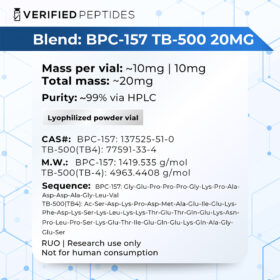
In addition to HPLC and MS, specialized labs might use orthogonal techniques for added accuracy. As an example, capillary electrophoresis can be utilized to separate really hydrophilic peptides or to confirm outcomes, and MALDI-TOF mass spectrometry can aid in mapping bigger or customized peptides. Many peptide producers or providers will supply a COA (Certification of Evaluation), for example our bpc 157 tb 500 blend, that consists of the pureness portion by HPLC and identification verification by MS for each and every set. Top-tier labs usually report peptide pureness well over 95%, regularly ≥ 98-99%, by using cutting edge HPLC and MS analyses. They additionally evaluate both raw materials and completed peptide vials, which helps capture any pollutants, destruction products, or formula variances.
What Is Hplc? The Standard Principle
They are labeled "for research study usage only" to make clear that they are meant for in vitro experiments or animal researches, except any type of form of human usage. As a matter of fact, a lab offering peptide testing have to supply data satisfying the strict logical assumptions of companies like FDA and EMA [4] By using a qualified third-party lab, peptide suppliers or scientists make sure an honest and skillfully documented evaluation of quality, which is specifically what examiners seek. Furthermore, recurring independent testing supports compliance in set release and quality control. Laboratory validation for peptides suggests utilizing scientific tests to validate a peptide's identification, pureness, and make-up. In technique, this typically involves third-party or independent screening by an external laboratory to confirm that a peptide item actually includes what the tag asserts [2]Throughout solid-phase synthesis, each amino acid coupling action has a yield of about 99-- 99.8%. When a coupling stops working, the expanding chain is covered to stop additional elongation of the inaccurate series. The result is a peptide that's much shorter than meant-- missing one or more amino acids.
The gold criterion for determining peptide pureness is high-performance liquid chromatography, universally abbreviated as HPLC. If you see a purity percentage on a peptide item, it probably came from an HPLC analysis. This matters because peptides are built one amino acid each time through solid-phase peptide synthesis (SPPS). At each step, there's a small opportunity that something fails-- an amino acid does not attach, the incorrect modification happens, or a side reaction creates an unintentional result. Over a chain of 10, 20, or 40 amino acids, those tiny per-step error prices compound. Peptide testing is the collection of logical checks used to review a peptide sample before it is made use of in a study workflow. In useful COA evaluation, the term generally describes pureness screening, identification screening, and documentation evaluation. Pureness screening asks how much of the detected sample is the primary peptide versus related pollutants. Identity screening asks whether the determined mass or website sequence-related proof matches the designated peptide. Paperwork review asks whether the record is batch-specific, traceable, and detailed enough to be audited. Peptide screening is the analytical process used to confirm that a study peptide is both pure and correctly determined.