Just How Are Peptides Checked? Hplc, Coa & Purity Clarified 2026
Peptide Screening: Hplc & Mass Spec Pureness Overview Peak For peptides, impurity assumptions comply with a risk-based FDA technique, rather than the small-molecule thresholds in ICH Q3A/Q3B (which leave out peptides). Peptide-related contaminations existing at low-percent degrees (e.g., around 0.1% and above) usually need characterization, and higher-level or new contaminations might need boosted justification due to prospective immunogenicity concerns. FDA advice and ICH Q2( R1) assistance specify needs for analytical approach validation and pollutant evaluation for peptide drug products. Pharma business wanting to establish peptide-based medicines need a solid QC testing program. This is very important due to the fact that it enables them to meet regulatory expectations and get authorization for peptide drugs. Unrefined peptides go through gel purification adhered to by HPLC filtration. HPLC purification is done by the state-of-art HPLC system with Empower Chromatography Manager. The system is Bacteriostatic Water validated by authorized Waters validation expert to follow FDA requirements. The pureness of the peptide is validated by running analytical HPLC followed by mass spectrum analysis. Researchers follow this link after that measure just how much of the total signal belongs to the primary top. If 98% of the signal comes from the appropriate peptide, the product is labeled "98% pure by HPLC." This is a typical means of sharing peptide high quality throughout research study and pharmaceutical markets. ESI-MS supplies remarkable efficiency for complicated blends or when MS/MS is needed for sequence confirmation. Choosing the correct purity from the beginning helps in reducing rework and preserves speculative uniformity across batches. Together, they develop the basis of a Certification of Analysis (COA) -- the official document that goes along with reputable research-grade peptides. Without both, researchers can't be totally confident in the top quality or reproducibility of their work. When you choose Emirates Peptides, you choose self-confidence in your study products. HPLC divides the parts of a peptide example based on their chemical homes as they travel through a specialized column under high pressure. A detector measures each part as it exits the column, generating a chromatogram-- a graph of the sample's composition.
Reliable Hplc Technique Development, Recognition, And Hplc Testing Services For All Stages Of Medication Growth
Mass Spectrometry (MS) is everything about measuring the specific molecular weight of a substance. Reach out today and learn just how we can aid you bring risk-free, effective peptide treatments to market. The peptide bond in the peptide is the amide bond, which generally has solid absorption at 220 nm (comparable to healthy protein), so we usually choose 220 nm as the detection wavelength of the peptide. If your peptide has a benzene ring structure such as Trp, Tyr and dye molecules alterations, we can additionally make use of 275 nm as the detection wavelength for detection as a referral. We are enjoyed finish our bioanalytical researches with their top quality and incredibly responsive group.How Peptides Are Evaluated: Essential Approaches
Just how much does peptide HPLC screening cost?
The price of peptide evaluation solution varies substantially based on which methods your regulatory bundle calls for: HPLC-UV Evaluation: $& #x 24; 300 & #x 2013; & #x 24; 800 per example (common purity evaluation) LC-MS (Fluid Chromatography-Mass Spectrometry): $& #x 24; 600 & #x 2013; & #x 24; 1,500 per sample (molecular weight confirmation).
Why Pureness Issues In Research
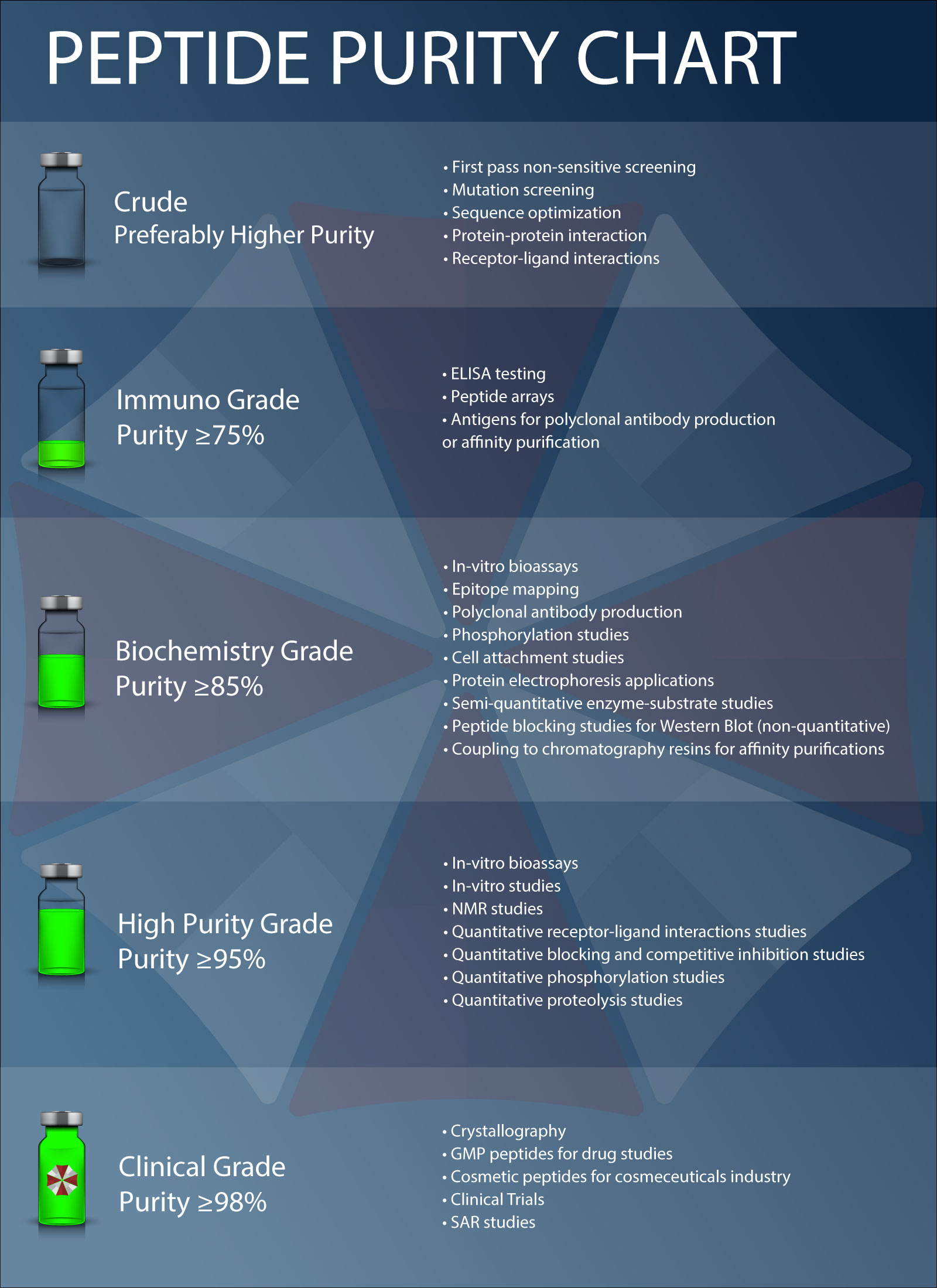
- HPLC and Mass Spectrometry give the gold-standard guarantee that what remains in the vial is pure, exact, and precisely what the tag claims.
- Inquire on instrumentation, detection restrictions, and recognition status prior to sending samples.
- With analytical screening, manufacturers can validate that peptide-based drugs fulfill governing criteria.
- Transform vial stamina, water quantity, and recommendation dosage right into exact syringe systems.
- For peptide pureness testing, reverse-phase HPLC is the common theoretical version.